

By Wayne Gillam / UW ECE News
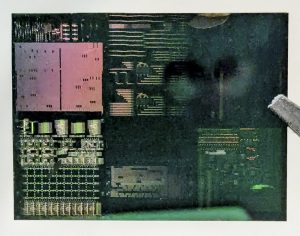
A research team led by UW ECE and Physics Professor Arka Majumdar has engineered a new type of optical microchip that is low power, electrically reconfigurable, and can be mass-produced. This programmable photonic integrated circuit (closeup shown above) could be used in a wide range of applications, including information processing, sensing, imaging, and artificial intelligence. Photo by Jayita Dutta.
As technology advances, and the demand for faster, higher-bandwidth, and more energy-efficient data processing continues to grow, scientists and engineers search for ways to improve electronic systems. One avenue they have been exploring is optoelectronics — the study and application of electronic devices that interface with light by detecting, emitting, or converting it into electrical signals. Optoelectronics offers significant advantages over conventional electronics, including faster speed, higher bandwidth, lower power consumption, and improved reliability.
One particularly promising direction in optoelectronics has been the development of the photonic integrated circuit — an optical microchip that uses light (photons) instead of electricity (electrons) to sense, process, and transmit information. These optical chips are already being used in many advanced technologies today, such as high-speed fiber-optic communications, data center interconnects, sensors for autonomous vehicles, and hardware accelerators for machine learning and artificial intelligence.
Despite these advantages, photonic integrated circuits present a major challenge: each optoelectronic application requires a separate photonic integrated circuit design, much like application-specific integrated circuits, or ASIC chips for conventional electronics. This lengthens the prototyping cycle and increases costs. As a result, engineers have been developing programmable photonic integrated circuits, which enable the circuit to be reconfigured by users after manufacturing to perform specific, customized computational and signal-processing tasks. This type of circuit is an optical counterpart to the more commonly known electronic field-programmable gate array, or FPGA, which is used in many of today’s high-performance and advanced technologies.
However, programmable photonic integrated circuits present their own challenges. Many consume significant power, occupy large physical footprints, and suffer from unwanted heat transfer in densely packed systems. High power demand arises because most optical chips require a constant flow of electricity, even during static operation. These limitations have slowed the adoption of programmable photonics beyond specialized research environments.

UW ECE and Physics Professor Arka Majumdar (left) and UW ECE alumnus Rui Chen (Ph.D. ECE ‘25, right), who was the lead author of the Science Advances paper. Chen is a postdoctoral research associate in the Photonics Materials Lab at MIT, and he was a doctoral student in Majumdar’s lab when this research took place. Photo of Majumdar by Ryan Hoover / UW ECE.
Now, as described in the journal Science Advances, a research team led by UW ECE and Physics Professor Arka Majumdar has engineered a new type of optical chip — a programmable photonic integrated circuit that is low power, electrically reconfigurable, and can be mass-produced. This programmable microchip addresses issues with device footprint and heat transfers by using phase change materials — a technology that consumes no static power. The chip has the potential to be applied in a wide range of technologies, including information processing, sensing, imaging, machine learning, and artificial intelligence.
“This optical chip could help to accelerate the prototyping cycle while reducing power consumption for applications like AI computing. Our study is also the first time someone has shown that these kinds of optical circuits can be controlled with electrical signals, reliably and very accurately,” said lead author and UW ECE alumnus Rui Chen (Ph.D. ECE ‘25). Chen is a postdoctoral research associate in the Photonics Materials Lab at MIT, and he was a doctoral student in Majumdar’s lab when the bulk of this research took place. He added, “We built our circuit using common foundry processes, which demonstrates the scalability of the system.”
Chen and Majumdar’s research team fabricated their chip in the Washington Nanofabrication Facility, on silicon wafers provided by Intel Corporation. Intel and the National Science Foundation’s Future of Semiconductors Program provided funding and support for the work, which took place over the last four years in Majumdar’s lab and at the WNF. Other team members included UW ECE doctoral students Andrew Tang, Jayita Dutta, and Virat Tara as well as UW alumni Julian Ye (BS Physics ‘25) and Zhuoran Fang (Ph.D. EE ‘23).
Low power, reconfigurable, scalable
A key advantage of the team’s optical chip is that it consumes substantially less power than its counterparts. It accomplishes this by using phase-change materials to store, process, and transmit data. Phase-change materials, which are used to house data on CDs and DVDs, can contain information in a stable, “nonvolatile” state, requiring little to no power to do so. Until now, the challenge with using phase-change materials in programmable photonic integrated circuits has been optical loss and data bit precision, but Majumdar and Chen’s team found ways to address both of those issues.
“Typical ways of building optical circuits require you to input constant power into your system. That’s problematic for a lot of applications that require reconfiguration of the circuit, such as artificial intelligence,” Chen said. “Here, we’ve created a system you can change and leave in place without any power supply, and it maintains its state by itself.”
This optical chip can also be reconfigured, or reprogrammed, by the user for multiple applications. Chen said he saw this chip as a platform for enabling a wide range of technologies, especially high-demand, complex computation applications, such as training neural networks in artificial intelligence. And because the research team has demonstrated the scalability of the circuit by fabricating it using conventional foundry processes, this chip is on a trajectory to move from the lab into the real world.
Looking ahead
This ongoing work highlights the growing role of UW ECE in advancing scalable optoelectronic technologies, but Chen noted that there is still more research and development to do before their optical chip will be ready for the marketplace. The UW and MIT are working together on this long-term effort, and Chen intends to continue his collaboration with Majumdar.
“An important next step is to test this optical chip in some real applications,” Chen said. “We’d like to put this circuit in application scenarios, such as AI computing, optical switches in data center infrastructure, and optical sensing.”
Another upcoming project will be for the team to build a larger-scale optoelectronic system containing the optical chip. This system will include the chip, an electrical control board, and automated algorithms. Chen said that he and Majumdar will also be working on increasing the speed and number of times the phase-change materials in the circuit can be switched from one state to another. This impacts the types of applications the chip might be a good fit for.
“This new optical chip provides a pretty powerful platform for the advancement of optoelectronics in the sense that it can promise a larger-scale system, it doesn’t need a complicated control scheme, and it doesn’t require static power,” Chen said. “Those factors, taken together, promise scalable optical systems, which eventually could lead to lower power consumption and reduced cost for many advanced applications and technologies coming online today.”
For more information about this research, read “NEO-PGA: Nonvolatile electro-optically programmable gate array” in Science Advances.