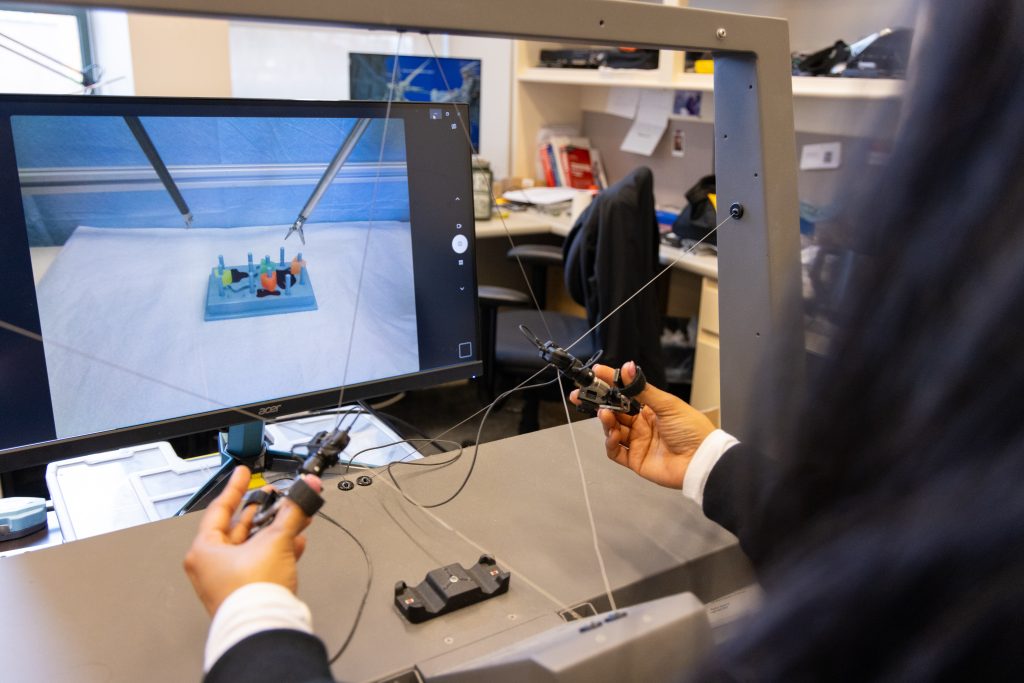
Biosystems research in UW’s Department of Electrical & Computer Engineering is a highly collaborative endeavor. Our faculty focus on four areas of Biosystems research: synthetic & systems biology, neural engineering, biomedical devices, and mobile health. Many of our faculty hold secondary appointments and work closely with collaborators from other departments including Bioengineering, Computer Science and Engineering, Biology, Genome Sciences, Applied Mathematics, and the UW Medical Center. Our Biosystems faculty work with many cross-disciplinary institutes such as the eScience Institute, the Center for Neurotechnology, the Institute for Protein Design, and the Bloedel Hearing Research Center.
Topics
Synthetic Biology
Biotechnology, macromolecular engineering tools, advanced materials, genetic engineering, computer aided design, laboratory automation, DNA/RNA sequence assembly, information theory and machine learning for genomics applications.
Design of biomedical devices including research and clinical neural interfaces, diagnostic devices, wearable sensors, and embedded processing and wireless communication links for biomedical devices.
Development of new health monitoring, diagnostics, and health management applications and tools using emerging mobile devices and sensors. Research in this area applies advances in imaging, app development, physiological modeling, statistical algorithms, and machine learning. This work has implications for home health monitoring and low-resource environments.
In new undergraduate capstone courses taught by UW ECE professors Chris Rudell and Ang Li, students are working together in teams to learn how to design and build microchips for real-world applications.
UW ECE Assistant Professor Yiyue Luo is known for her work in intelligent, or “smart,” textiles. At UW ECE, she and her students are expanding this relatively new line of research into other forms of intelligent wearable technology.
UW ECE and Allen School Professor Shwetak Patel was recently elected part of the 2026 class of the American Academy of Arts & Sciences for his pioneering contributions to computer science.
UW ECE is proud to announce that Khushbu Patel (MSECE ‘26) and Kathryn Fehme (BSECE ‘26) have been selected to speak at this year's Graduation Ceremony.
UW ECE Professor Emeritus Akira Ishimaru spent 73 years at UW ECE focused on learning. His talent and hard work led to important contributions in the study of electromagnetic wave propagation, launched the careers of many of his students, and laid a foundation for the advanced technologies we rely on today.
UW ECE undergraduate student Anders Pearson has been awarded a fellowship by the National Science Foundation (NSF) Graduate Research Fellowship Program (GRFP). The NSF GRFP recognizes outstanding graduate students pursuing research-based degrees in STEM.